Vaser 360 Lipo

Vaser 360 Lipo is ultrasound-assisted liposuction that treats the torso all the way round: upper and lower abdomen, flanks and lower back. It suits adults near their ideal weight wanting a narrower waist, and Dr Edwin Anthony performs it at Langham Hospital, Marylebone.

What Vaser 360 Lipo treats

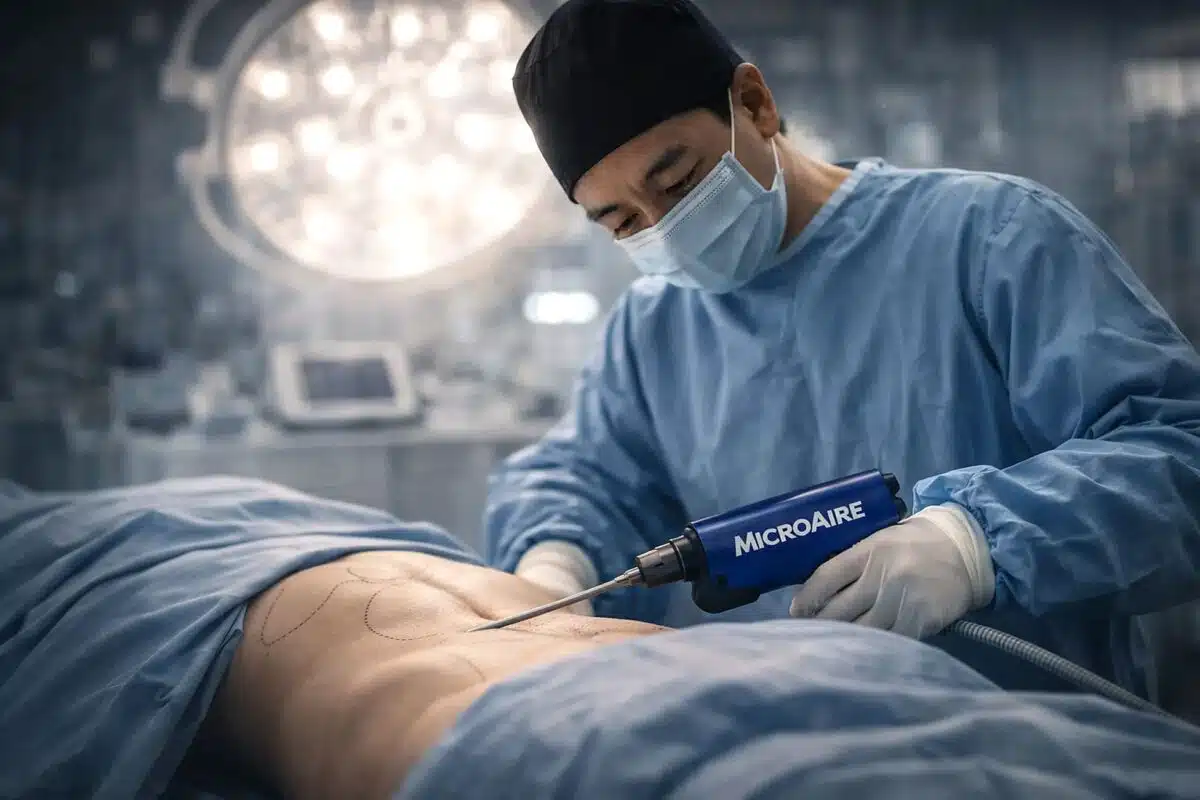
Vaser 360 Lipo is a single, planned operation on the midsection. It covers four linked zones:

  • The upper abdomen, above the belly button
  • The lower abdomen, including the lower tummy bulge
  • The flanks, often called love handles
  • The lower third of the back, where fat tends to roll over a waistband

VASER ultrasound loosens the fat in each zone before it is removed through small entry points, and Dr Anthony blends the areas into one another so there is no step between front and back.

Why treat the waist all the way round

Many people who ask about their stomach are really bothered by the width of their waist. Treating only the front can leave the flanks and lower back looking fuller by comparison, and the change is less noticeable in clothes or from the side. Working around the whole circumference reduces the waist measurement more evenly and gives a more balanced silhouette from every angle.

Who it suits, and its limits

The typical patient is an adult, 18 or over, close to their goal weight, with a waistline that has not changed despite steady diet and exercise, and with reasonable skin quality. It is surgery, so you need to be in good general health and a non-smoker.

It will not tighten separated stomach muscles or remove an overhang of skin after pregnancy or major weight loss. If you have a firm, rounded stomach that pushes outwards, much of that may be visceral fat. The NHS stresses that liposuction is not a treatment for obesity, and Dr Anthony will tell you plainly if another route would help you more.

How it compares

Factor Vaser Lipo to the abdomen Vaser 360 Lipo Vaser 4D Lipo
Zones covered Front of the tummy Abdomen, flanks and lower back together Several areas, which may extend beyond the torso
Main goal Flatter front Narrower waist from every angle Larger reduction with anatomical shaping
Anaesthetic Local anaesthetic Local anaesthetic, IV sedation available Mainly IV sedation with local anaesthetic
Positioning in theatre On your back Front and back, turned during surgery Depends on areas

Preparing for surgery and the day itself

  1. Weeks before: stop smoking, eat well and stop medicines or supplements that increase bleeding, as advised in your tailored pre-operative checklist.
  2. Plan ahead: arrange around a week off desk work and someone to help at home for the first day or two.
  3. On the day: Dr Anthony marks your torso while you stand. The procedure is done under local anaesthetic, and IV sedation is available if you would like it.
  4. Going home: you are usually ready to leave about an hour after the procedure finishes, wearing your compression garment.

Recovery week by week

  • Days 1 to 3: soreness, tightness and tenderness are at their most noticeable. Prescribed pain relief helps.
  • Days 5 to 7: things become noticeably easier. Many people return to desk-based work at about one week.
  • Weeks 1 to 3: compression is worn day and night. Pre-planned lymphatic massage helps swelling move.
  • Weeks 4 to 6: compression continues for around eight hours a day.
  • Weeks 6 to 12: most of the refinement in shape happens.
  • Months 3 to 6: final contours settle, depending on how you heal.

Results, risks and safety

Most people aim for a smaller waist and a more athletic outline. Your result depends on your starting shape, how your fat is distributed, your skin and your healing. The fat removed does not return, but remaining cells can grow with weight gain. Results cannot be promised.

Risks include bleeding, infection, fluid collections, contour irregularity, numbness, prolonged swelling, pigmentation change and, rarely, blood clots. Published data give a sense of scale:

Why patients choose Dr Edwin Anthony

Circumferential work relies on judgement about how the back, sides and front meet. Dr Anthony has built that judgement over 14 years of dedicated VASER practice and more than 1,500 VASER procedures, after NHS plastic surgery and burns training and further training with Dr Alfredo Hoyos. He is Lead Clinician at Contoura Medical (GMC 4776646), a Trinity College Dublin graduate (MB BCh BAO) with MRCS (Edinburgh), and he carries out every operation personally at Langham Hospital, under its CQC registration.

Related procedures

Book a consultation at Langham Hospital, 77 Hallam Street, Marylebone, London W1W 5HB, or by video, by calling 020 3890 1911. Consultation fees are fixed and are not deducted from treatment prices. Your full price for Vaser 360 Lipo is confirmed in writing after consultation, with IV sedation, if chosen, and hospital theatre fees itemised. Finance is available through Chrysalis Finance. Book a consultation

Frequently asked questions

Which areas does Vaser 360 Lipo include?

It includes the upper abdomen, lower abdomen, both flanks and the lower third of the back. Treating these together in one operation lets Dr Anthony reduce the waist evenly and blend the front, sides and back, so the new shape looks natural from every angle rather than only from the front.

Can Vaser 360 Lipo get rid of a tummy pouch?

It can reduce the fatty part of a pouch and improve the waist. It cannot repair separated stomach muscles or remove excess skin, which are common after pregnancy or large weight loss. If those are the main cause, Dr Anthony will explain what fat removal can and cannot achieve and discuss other options.

Does Vaser 360 Lipo remove visceral fat?

No. Visceral fat lies deep inside the abdomen around the organs and cannot be reached by any liposuction. Vaser 360 Lipo treats the fat layer beneath the skin. Visceral fat responds to weight loss, activity and diet, and reducing it is also good for your general health.

What anaesthetic is used for Vaser 360 Lipo?

The procedure is performed under local anaesthetic, which numbs the whole treated area while you stay awake. IV sedation is available if you would prefer to be drowsy and relaxed, and its fee is itemised separately in your quote. Most patients go home around an hour after the procedure ends.

Is Vaser 360 Lipo painful?

Expect soreness, tightness and tenderness for the first one to three days, with bruising and swelling. It usually becomes much easier by days five to seven. Prescribed pain relief, regular short walks and pre-planned lymphatic massage all help, and most people describe the discomfort as manageable.

How long do I wear compression after Vaser 360 Lipo?

Usually for three weeks day and night, followed by a further three weeks for around eight hours a day. Compression reduces swelling, supports the skin while it adapts to the new shape and makes moving about more comfortable. Dr Anthony will confirm your exact garment plan at your follow-up appointments.

When will I see the final result?

Early changes show once the swelling starts to go down. Most of the refinement happens between six and twelve weeks, and the final contour can take three to six months to settle. Swelling in the lower abdomen often lingers longest, so it is worth judging the result at the later milestones.

What are the risks of Vaser 360 Lipo?

Risks include bleeding, infection, seroma, contour irregularity, numbness, prolonged swelling, pigmentation change and, rarely, blood clots. Careful assessment, sterile technique, sensible volume limits and good aftercare reduce these risks. Dr Anthony goes through your personal risk profile before you decide whether to go ahead.

How much does Vaser 360 Lipo cost?

Vaser 360 Lipo is priced as a torso procedure, and the current figure is on our price list. Your full price is confirmed in writing after consultation, with IV sedation and hospital theatre fees itemised if they apply. Chrysalis Finance is available, and consultation fees are fixed and are not deducted from treatment prices.

Who performs Vaser 360 Lipo at Contoura Medical?

Dr Edwin Anthony, Lead Clinician at Contoura Medical (GMC 4776646), performs every Vaser 360 Lipo himself at Langham Hospital, Marylebone. He trained in NHS plastic surgery and burns units and with Dr Alfredo Hoyos, and has performed more than 1,500 VASER procedures over 14 years of dedicated practice.
Sources

  1. Liposuction, NHS
  2. Nationwide Analysis of Complications and Risks Associated With Types of Liposuction in 69,424 Patients, Aesthetic Surgery Journal
  3. Safety and Efficacy of Third-Generation Ultrasound-Assisted Liposuction: A Series of 261 Cases, Aesthetic Plastic Surgery (PubMed)

Bodytite

BodyTite Turbo is radiofrequency-assisted liposuction: it melts and removes fat while heating the tissue under the skin so it contracts. It suits adults with moderate fat and loose skin. Dr Edwin Anthony performs it under local anaesthetic with IV sedation at Langham Hospital, Marylebone.

What BodyTite Turbo is and how it works

BodyTite Turbo is the current generation of InMode’s BodyTite system, a form of radiofrequency-assisted liposuction (RFAL). It uses two electrodes. An internal cannula sits in the fat under the skin, and an external electrode glides over the skin surface. Radiofrequency energy flows between them, heating the fat so it liquefies and warming the connective tissue so it contracts. The softened fat is then removed by gentle suction.

Built-in temperature sensors on the inner and outer electrodes help keep heating within set limits. It is liposuction, and therefore surgery, carried out in an operating theatre through small entry points. Dr Edwin Anthony has offered BodyTite since 2018.

Who it suits, and who it does not

  • Adults aged 18 and over, at or near a stable weight
  • Moderate pockets of fat with some skin laxity in the same area
  • Common areas: abdomen, flanks, arms, inner and outer thighs, knees, male chest and under the chin

BodyTite Turbo is not a weight-loss treatment. Where the main goal is removing a larger volume of fat or creating athletic definition, Vaser Lipo or Vaser 4D Lipo is usually the better starting point. If there is loose skin but very little fat, heating and removing fat you do not need makes little sense, and QuantumRF may suit you better. Hanging skin needs surgical removal.

The procedure day at Langham Hospital

  1. Marking. Dr Anthony maps the treatment zones with you standing.
  2. Anaesthetic. Local anaesthetic with IV sedation given by an anaesthetist.
  3. Radiofrequency stage. The cannula and external electrode treat each zone, with temperatures monitored throughout.
  4. Fat removal. The liquefied fat is removed through the same small entry points.
  5. Garment. Dressings and a compression garment are applied before you go home.

The procedure typically takes 1 to 3 hours, depending on the number of areas.

Recovery timeline

  • Days 1 to 3: swelling, bruising, soreness and fluid leakage from entry points. Walk little and often.
  • Days 3 to 7: most patients return to light activities and desk-based work.
  • Weeks 2 to 3: more strenuous exercise usually resumes, on Dr Anthony’s advice.
  • Weeks 4 to 6: the compression garment is worn throughout this period.
  • Months 3 to 6: swelling settles and skin contraction continues as collagen remodels.

Results and what the evidence shows

Fat cells removed do not come back, although remaining fat can enlarge with weight gain. Skin tightening develops gradually.

  • A 2015 comparison in 10 patients found 22.6% linear contraction at 12 months in arms treated with RFAL, against 17.8% with aggressive superficial liposuction alone. Skin surface area on the front of the arm reduced by 15.0% with RFAL.
  • The study was small, so it shows the principle rather than what any individual can expect.

Risks and safety

As with any liposuction, expected effects include bruising, swelling, numbness and firmness. Less common risks include burns, seroma, haematoma, contour irregularity, raised scars, infection and, rarely, blood clots.

In a 2024 single-centre review, 236 BodyTite patients had burns in 4.2% and seroma in 10.2% of cases. That review was sponsored by the maker of a competing device, but it is a useful reminder that energy devices need careful technique. The NHS advises checking that your doctor is on the GMC register and that the hospital is registered with the CQC.

How it compares

Factor BodyTite Turbo Vaser Lipo Quantum Vaser Lipo
Energy Bipolar radiofrequency Ultrasound Ultrasound, then subdermal RF
Best for Moderate fat with laxity Fat with good skin tone Fat and mild laxity, with definition
Definition work Limited Good, more with Vaser 4D Lipo Good
Anaesthetic Local with IV sedation Local anaesthetic Local with IV sedation

Put simply, BodyTite Turbo leans towards tightening with fat removal, while VASER leans towards precise sculpting. Quantum Vaser Lipo aims to combine both.

Why patients choose Dr Edwin Anthony

  • Dr Edwin Anthony, Lead Clinician, Contoura Medical (GMC 4776646), personally performs every procedure
  • Over 1,500 VASER procedures, 14 years of dedicated VASER practice and BodyTite experience since 2018
  • MRCS (Edinburgh), Trinity College Dublin graduate, NHS plastic surgery and burns training
  • Regulated services provided under Langham Hospital’s CQC registration

Related procedures

Consultations take place with Dr Edwin Anthony at Langham Hospital, 77 Hallam Street, Marylebone, London W1W 5HB, 2 minutes’ walk from Great Portland Street and Regent’s Park stations, or by video. Call 020 3890 1911. Consultation fees are fixed and are not deducted from treatment prices. Your full price is confirmed in writing after consultation, with theatre fees and IV sedation itemised. Book a consultation

Frequently asked questions

What is BodyTite Turbo?

BodyTite Turbo is radiofrequency-assisted liposuction. A cannula under the skin and an electrode on the surface pass radiofrequency energy between them, melting fat and heating the connective tissue so it contracts. The fat is then removed by gentle suction. It is a surgical procedure carried out in theatre through small entry points.

How is BodyTite Turbo different from the original BodyTite?

BodyTite Turbo is the newer generation of the same radiofrequency-assisted liposuction system. It is designed to deliver energy more efficiently, which can shorten treatment time. The principle is unchanged: fat is melted and removed while the tissue under the skin is heated to contract. Dr Anthony can explain the device differences at consultation.

Which areas can BodyTite Turbo treat?

Common areas include the abdomen, flanks, upper arms, inner and outer thighs, knees, the male chest and under the chin. It is most effective where there is a moderate amount of fat with some loose skin over it. Areas with firm skin are often better treated with VASER, and loose skin with little fat with QuantumRF.

What anaesthetic is used for BodyTite Turbo?

BodyTite Turbo is usually performed under local anaesthetic with IV sedation, given by an anaesthetist at Langham Hospital. You are relaxed and comfortable, breathing on your own, without a general anaesthetic. Most patients go home the same day and need someone to accompany them home.

What is recovery like after BodyTite Turbo?

Expect swelling, bruising and soreness for the first few days. Most patients return to light activities within a few days and strenuous exercise after two to three weeks. A compression garment is worn for four to six weeks. Swelling and skin tightening continue to settle over three to six months.

How long do BodyTite Turbo results last?

Fat cells removed during the procedure do not return, although the remaining fat cells can enlarge if you gain weight. The tightening comes from contracted tissue and new collagen, which is long-lasting, but natural ageing continues. Keeping a stable weight is the most effective way to protect your result.

Is BodyTite Turbo better than VASER?

Neither is better in general; they suit different tissue. VASER is well suited to sculpting and removing fat where the skin has good tone. BodyTite Turbo suits moderate fat with some laxity. Quantum Vaser Lipo combines VASER shaping with QuantumRF tightening. Dr Anthony recommends an approach after examining you.

What are the risks of BodyTite Turbo?

Bruising, swelling, numbness and firmness are common. Less common risks include burns, seroma, haematoma, contour irregularity, raised scars, infection and, rarely, blood clots. A 2024 review of 236 BodyTite patients reported burns in 4.2% of cases. Careful technique and temperature monitoring reduce risk, and Dr Anthony will discuss yours in detail.

How much does BodyTite Turbo cost?

The cost depends on the number of areas and whether BodyTite Turbo is added to Vaser 4D Lipo. Your full price is confirmed in writing after consultation, with hospital theatre fees and IV sedation itemised. Our price list shows current fees, and finance is available through Chrysalis Finance for eligible patients.

Who performs BodyTite Turbo at Contoura Medical?

Dr Edwin Anthony, Lead Clinician at Contoura Medical, GMC 4776646, personally performs every BodyTite Turbo procedure. He has offered BodyTite since 2018, has performed over 1,500 VASER procedures and trained with Dr Alfredo Hoyos in high-definition liposculpture. Treatment takes place at Langham Hospital in Marylebone, London.

Sources

  1. Radiofrequency-Assisted Liposuction Compared with Aggressive Superficial, Subdermal Liposuction of the Arms: A Bilateral Quantitative Comparison, Plastic and Reconstructive Surgery Global Open (PMC)
  2. A Retrospective Review Comparing Renuvion Helium Plasma Radiofrequency with BodyTite Bipolar Radiofrequency after Liposuction or Body Contouring, Plastic and Reconstructive Surgery Global Open (PMC)
  3. Liposuction, NHS

Vaser 4D Lipo

Vaser 4D Lipo is ultrasound-assisted liposuction for larger volumes across several areas, shaped around your natural anatomy. It is mainly performed under IV sedation with local anaesthetic, by Dr Edwin Anthony at Langham Hospital, Marylebone, London.

What Vaser 4D Lipo is

Vaser 4D Lipo uses the same VASER ultrasound as our standard procedure, but the plan is different. Rather than simply reducing fat in one or two zones, Dr Anthony works across several connected areas in one operation, such as the abdomen, waist, flanks and back, and sculpts the transitions between them.

The “4D” refers to planning around anatomy rather than volume alone. Dr Anthony considers where muscles sit, how light and shadow fall on the body, and how the shape looks when you move as well as when you stand still. The result he aims for is proportionate and natural, with gentle definition where your anatomy supports it.

It is a surgical procedure performed in theatre. It is also not a weight-loss operation: the NHS advises that liposuction is only really suitable for people who have already tried lifestyle changes.

Who it suits

  • Adults aged 18 and over who are medically fit for surgery
  • People close to their ideal weight with stubborn fat in several areas
  • Those wanting a larger overall reduction than Vaser Lipo can safely offer under local anaesthetic alone
  • Men seeking a more athletic torso, chest and arms
  • Women seeking a shapelier waist and smoother transitions between hips, back and thighs
  • Reasonable skin quality, or willingness to add skin tightening

If your main concern is loose skin, or muscle separation after pregnancy, fat removal alone will not fix it. Dr Anthony will discuss whether skin tightening or a referral for surgical skin removal would be more sensible.

How it differs from Vaser Lipo and Vaser Hi-Def

Factor Vaser Lipo Vaser 4D Lipo Vaser Hi-Def
Anaesthetic Local anaesthetic Mainly IV sedation with local anaesthetic Local anaesthetic with IV sedation
Volume Modest, up to five areas Larger, across several areas Usually modest, as patients are lean
Definition Smooth reduction Anatomical shaping, gentle definition Pronounced muscular definition
Typical patient Localised stubborn fat Multi-area contouring near ideal weight Very lean, trains regularly

Anaesthetic and the day of surgery

Most Vaser 4D Lipo is carried out under IV sedation combined with local anaesthetic. Sedation, given by an anaesthetist, keeps you relaxed and drowsy while the local anaesthetic numbs each area, which makes a longer multi-area session much more comfortable. General anaesthetic is only used on special request. You go home the same day with an adult to collect you.

Recovery milestones

  1. Same day: walking gently at home.
  2. First few days: light activity around the house. Soreness, swelling, bruising and tightness are expected.
  3. Around day 5: most people return to desk work.
  4. 1 to 2 weeks: light gym work.
  5. 2 weeks: swimming, once the entry points have healed.
  6. 4 to 6 weeks: intense exercise.
  7. 6 weeks: contact sport.

Initial changes show at 2 to 6 weeks, the major improvement at 3 to 6 months, and final refinement can continue for up to 12 months.

Compression garments

Stage 1 compression goes on straight after surgery, and many patients move to a lighter stage 2 garment later in recovery. Dr Anthony recommends properly fitted medical-grade garments, commonly from RECOVA or MACOM, rather than high-street shapewear, because even compression helps control swelling and supports the skin as it settles. The exact style depends on the areas treated and your measurements.

Risks and safety

All surgery carries risks, and treating several areas in one session means a longer operation. Possible problems include bleeding, infection, seroma, contour irregularity, asymmetry, temporary numbness, prolonged swelling, skin burns from the ultrasound probe, anaesthetic risks and occasionally the need for revision.

Why patients choose Dr Edwin Anthony

Dr Anthony trained directly with Dr Alfredo Hoyos, who developed high-definition liposculpture, and anatomical shaping has been central to his work since. He is Lead Clinician at Contoura Medical (GMC 4776646), graduated from Trinity College Dublin (MB BCh BAO), holds MRCS (Edinburgh) and spent years in NHS plastic surgery and burns training. With more than 1,500 VASER procedures across 14 years, he operates on every patient himself at Langham Hospital, which holds the CQC registration for these services.

Related procedures

Your consultation can be at Langham Hospital, 77 Hallam Street, Marylebone, London W1W 5HB, or by video; call 020 3890 1911 to arrange it. Consultation fees are fixed and are not deducted from treatment prices. After assessing you, Dr Anthony confirms the full cost in writing, with IV sedation and hospital theatre fees itemised. Chrysalis Finance is available. Book a consultation

Frequently asked questions

What does the 4D in Vaser 4D Lipo mean?

It describes a way of planning rather than a separate machine. Dr Anthony shapes the body around its natural anatomy, considering muscle position, shadowing, the transitions between areas and how the body looks in movement. The aim is a proportionate, athletic look that suits your frame, rather than simply taking out as much fat as possible.

What anaesthetic is used for Vaser 4D Lipo?

Most patients have IV sedation combined with local anaesthetic. The sedation keeps you relaxed and drowsy, while the local anaesthetic numbs each treated area. General anaesthetic is available only on special request. The anaesthetic plan is discussed at consultation, and the sedation fee is itemised separately in your written quote.

How is Vaser 4D Lipo different from standard Vaser Lipo?

Standard Vaser Lipo is done under local anaesthetic alone and suits modest, localised reductions. Vaser 4D Lipo treats larger volumes across several areas in one session, usually under sedation, and adds anatomical shaping so the areas blend together. It suits people wanting a broader change in body shape while staying near their ideal weight.

Am I a good candidate for Vaser 4D Lipo?

You may be suitable if you are an adult close to your ideal weight, have stubborn fat in several areas despite diet and exercise, have reasonable skin quality and are fit for surgery. Realistic expectations matter too. Dr Anthony will examine you in person before recommending anything, and will say if another option fits better.

How long does recovery take?

You walk the same day and most people return to desk work after about five days. Light gym work resumes at one to two weeks, swimming at two weeks, intense exercise at four to six weeks and contact sport at six weeks. Swelling continues to improve for several months, so be patient with the early shape.

Is Vaser 4D Lipo painful?

You should be comfortable during surgery thanks to the sedation and local anaesthetic. Afterwards, soreness, swelling, bruising and a tight feeling are common, particularly for the first week. Prescribed pain relief usually keeps this manageable, and it eases steadily over the following few weeks as the tissues settle.

How much does Vaser 4D Lipo cost?

Cost depends on the number of areas, the volume to be removed and the sedation required. Dr Anthony gives you the full price in writing after your consultation, with IV sedation and hospital theatre fees itemised, and indicative figures are on our price list. Finance through Chrysalis Finance is available if you would like to spread the cost.

Can Vaser 4D Lipo tighten loose skin?

VASER can encourage some skin contraction, especially in people with good elasticity. Where laxity is more noticeable, Dr Anthony may suggest adding QuantumRF or Renuvion beneath the skin in the same session. When the skin is very loose, surgical removal may be the honest answer, and he will explain that at consultation.

What are the risks of Vaser 4D Lipo?

Risks include bleeding, infection, seroma, contour irregularity, asymmetry, temporary numbness, prolonged swelling, skin burns, anaesthetic complications and occasionally the need for revision. A longer, multi-area operation carries more risk than a small one, so your health, the volume planned and any combined treatments are all weighed before surgery is offered.

Who performs Vaser 4D Lipo at Contoura Medical?

Dr Edwin Anthony, Lead Clinician at Contoura Medical (GMC 4776646), performs every Vaser 4D Lipo procedure himself at Langham Hospital, Marylebone. He trained with Dr Alfredo Hoyos in high-definition liposculpture, holds MRCS (Edinburgh) and has completed more than 1,500 VASER procedures over 14 years of dedicated practice.

Sources

  1. Liposuction, NHS
  2. High-Definition Liposculpture 18-Year Evolution: Patient Safety and Aesthetic Outcomes, Plastic and Reconstructive Surgery (PubMed)
  3. Cosmetic Liposuction: Preoperative Risk Factors, Major Complication Rates, and Safety of Combined Procedures, Aesthetic Surgery Journal