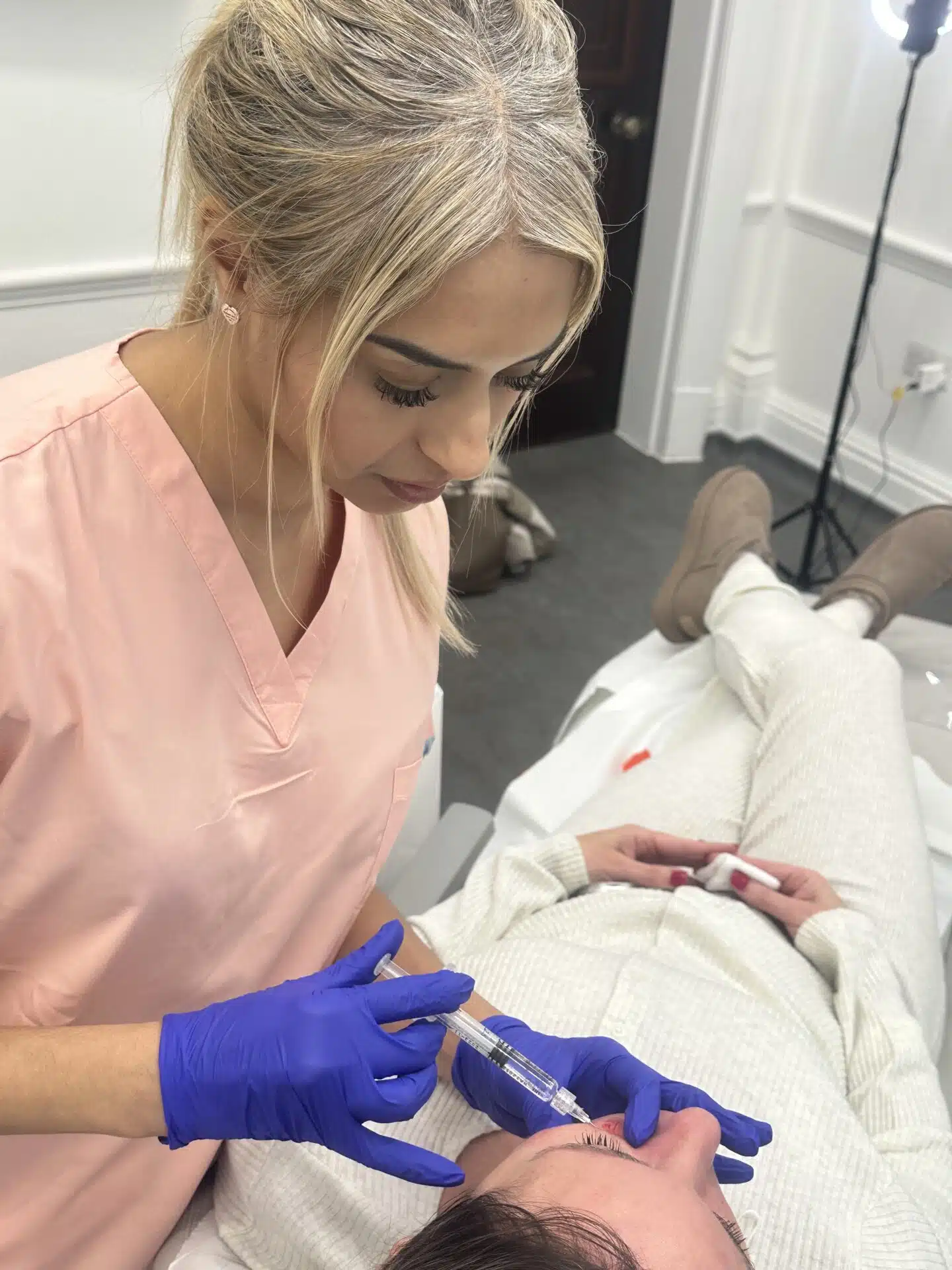
Facial volumising uses injectable treatments such as Radiesse®, a calcium hydroxylapatite filler, and NCTF, a skin revitalising treatment, to address volume loss and support skin quality. The appropriate product and approach depend on individual facial assessment at Orovenza, part of Contoura Medical.
At Orovenza, treatment begins with an assessment of your facial structure and skin, so the most suitable combination of products and techniques can be discussed.
Treatment Information
Treatment Details
What It Treats
Volume loss, structural support and skin quality concerns affecting the face.
Products Used
Radiesse® for structural volumising and NCTF for skin revitalisation, used individually or in combination.
Downtime
Some swelling or bruising can occur following treatment, with individual recovery discussed beforehand.
Results Timeline
Initial results are visible after treatment, with some products continuing to stimulate improvement over subsequent weeks.
The Process
How Facial Volumising Works
Consultation
Your facial structure, skin quality and goals are assessed.
Treatment Planning
An appropriate product and technique are proposed based on your assessment.
Treatment
The product is carefully placed according to the agreed treatment plan.
Aftercare
Aftercare guidance is provided and results reviewed as swelling settles.
By Dr Edwin Anthony, Lead Clinician, Contoura Medical · Treatments delivered by Nurse Rashmi Mehta · Last updated 4 October 2026
Facial volumising is an injectable treatment that restores lost support in the cheeks, jawline and temples. At Orovenza in Marylebone, London, we use Radiesse with NCTF, a calcium-based collagen stimulator, and Hyaluronic Acid where suitable, for adults wanting fresher, natural-looking structure.
What it is and how it works
With age, we lose bone density, fat pads shrink and the skin makes less collagen. The face can look flatter and more tired. Volumising treatment replaces some of that support in a measured way.
Radiesse with NCTF is a regenerative volumising treatment. Its calcium-based microspheres give immediate lift, then act as a scaffold that prompts your own cells to build new collagen over the following months. The combination with NCTF is designed to support skin quality alongside structure.
Hyaluronic Acid filler is a smooth gel that adds volume immediately and can be dissolved if needed. Nurse Rashmi Mehta often combines the two: Radiesse with NCTF for deeper support and skin quality, Hyaluronic Acid for finer, more delicate areas.
Who it is best suited for
Adults noticing flatter cheeks or hollowing at the temples
People who want a crisper jawline or softer jowls without surgery
Anyone with thinning, crêpey skin who wants firmer, better-quality skin
Patients who prefer gradual, natural change over a dramatic one
Your treatment journey at Orovenza
Consultation. Rashmi assesses your face at rest and in movement, along with your medical history and previous treatments.
Plan. Together you choose which areas to treat and whether Radiesse with NCTF, Hyaluronic Acid or both suit you best.
Treatment day. The skin is cleansed and numbed. Products are placed with a fine needle or cannula, usually within 30 to 45 minutes.
Aftercare. You go home with written aftercare advice and a number to call if you have concerns.
Review. We see you again at around two weeks to check the result and discuss whether any refinement would help.
Results and how long they last
You will notice a lift straight away. With Radiesse with NCTF, skin firmness and quality continue to improve over the next two to three months as new collagen forms.
Save Face reports that calcium hydroxylapatite results typically last 12 to 18 months or longer, while Hyaluronic Acid fillers usually last 6 to 18 months.
A 2023 review in Aesthetic Surgery Journal cites one study in which calcium hydroxylapatite increased total collagen by around 160% compared with untreated controls.
In a long-term study of calcium hydroxylapatite in the nasolabial folds, 40% of treated folds were still rated improved at least 30 months after the last treatment.
Recovery and aftercare
Mild swelling, tenderness and redness are common for 2 to 5 days.
Bruising can occur and usually fades within 7 to 10 days.
Avoid make-up for 12 hours and strenuous exercise, saunas and alcohol for 48 hours.
After Radiesse with NCTF, you may be asked to massage the area gently for a few days. Follow the instructions you are given.
Contact us urgently if you notice increasing pain, colour change or blanching of the skin.
Safety, side effects and who should avoid it
Common side effects are swelling, bruising, tenderness and temporary lumpiness.
Rarer risks include infection, nodules and, very rarely, a blocked blood vessel. We treat in a medical setting with emergency protocols.
We do not use Radiesse with NCTF in the lips or directly under the eyes. Hyaluronic Acid is the safer choice in those areas.
In the UK, dermal fillers are not prescription-only, so anyone can legally buy and inject them. Choosing a medically led clinic matters.
The NHS recommends checking practitioners on an accredited register such as the JCCP or Save Face.
Cosmetic fillers cannot legally be given to under 18s in England.
Treatment is not suitable in pregnancy or breastfeeding, with active skin infection, or with an allergy to any ingredient. Some autoimmune and bleeding conditions need careful review first.
Radiesse with NCTF compared with Hyaluronic Acid
Option
What it treats
How it works
How long it lasts
Downtime
Radiesse with NCTF
Cheeks, jawline, temples, skin firmness and quality
Calcium-based microspheres lift, then stimulate your own collagen
Typically 12 to 18 months or longer
Swelling and tenderness for a few days
Hyaluronic Acid filler
Volume and contour, including delicate areas
Gel adds volume immediately and can be dissolved
Usually 6 to 18 months
Swelling for a few days, possible bruising
Skin booster (such as Profhilo)
Hydration, crêpey skin, fine texture
Spreads through the skin to hydrate and support elasticity
Usually shorter; a course is typical
Small bumps for 24 hours
How Orovenza compares
Treatment in a hospital setting at Langham Hospital, 77 Hallam Street, Marylebone.
Nurse-led by Nurse Rashmi Mehta, with doctor oversight from Dr Edwin Anthony, Lead Clinician at Contoura Medical, and a prescriber on site.
A consultation before every treatment, so the plan reflects your face as it is today.
A fixed consultation fee, not deducted from treatment prices, so advice is independent of what you choose.
Both Radiesse with NCTF and reversible Hyaluronic Acid available, so the product is chosen for the area rather than the other way round.
To find out whether volumising suits you, book a consultation with Nurse Rashmi Mehta at Langham Hospital, or call 020 3890 1911. Consultation fees are fixed and are not deducted from treatment prices, and your practitioner confirms your personal treatment cost at consultation. Book a consultation
Frequently asked questions
What affects the cost of facial volumising?
Cost depends on how many areas are treated, how much product is needed and whether Radiesse with NCTF, Hyaluronic Acid or a combination suits you. Some people need one session, others two. Your practitioner confirms your personal treatment cost at consultation, after a proper assessment. The consultation fee is fixed and separate from treatment prices.
Does facial volumising hurt?
Most patients find it very manageable. We use numbing cream, and the products we use contain or are mixed with local anaesthetic, so discomfort eases quickly once treatment starts. You may feel pressure and some tenderness, particularly along the jawline.
How long does swelling and bruising last?
Swelling is usually mild and settles within 2 to 5 days. Bruising does not always happen, but if it does it typically fades within 7 to 10 days and can be covered with make-up after 12 hours. Plan treatment at least two weeks before an important event.
How long does Radiesse with NCTF last?
Calcium hydroxylapatite results typically last 12 to 18 months or longer, according to Save Face, which is often longer than Hyaluronic Acid. Because it encourages your own collagen, some improvement in skin quality can remain after the product itself has broken down.
When will I see results?
You will see some lift immediately after treatment. With Radiesse with NCTF, the result keeps developing over roughly two to three months as new collagen forms, so skin looks firmer and smoother over time. Hyaluronic Acid results are visible straight away and settle once swelling goes down, usually by the two-week review.
Can facial volumising be reversed?
Hyaluronic Acid filler can be dissolved with an enzyme called hyaluronidase. Radiesse with NCTF cannot be dissolved in the same way, though it gradually breaks down naturally. That difference is why we discuss reversibility at consultation, and why first-time patients may be advised to start with Hyaluronic Acid before moving to a collagen-stimulating treatment.
Will I look overfilled?
Overfilled faces usually come from too much product, too many areas at once or the wrong product for the area. Rashmi works conservatively, restoring support where it has been lost rather than adding volume for its own sake. Many patients hear that they look well rested, not that they have had something done.
What should I know before my first volumising treatment?
Bring older photos of yourself, as they help show where volume has changed. Avoid blood-thinning supplements and alcohol for a day or two beforehand if your doctor agrees, to reduce bruising. Expect a gradual plan rather than one big change. A good consultation should leave you clear about what is realistic.
Who should not have facial volumising?
Cosmetic fillers cannot be given to under 18s in the UK. We also avoid treatment during pregnancy or breastfeeding, with active skin infection or cold sores, or with an allergy to any ingredient. People with some autoimmune conditions, bleeding disorders or a tendency to raised scarring need careful assessment first, and treatment may not be advised.
Is Radiesse with NCTF or Hyaluronic Acid better for me?
Radiesse with NCTF suits deeper structural areas such as the cheeks, jawline and temples, especially when skin quality is also a concern. Hyaluronic Acid suits delicate areas and anyone who wants the option to dissolve it. Many plans use both. Your consultation weighs your anatomy, goals and preferences before recommending either.
Pricing depends on the treatment plan and number of sessions required. Your practitioner will confirm the cost of your personal treatment plan at consultation. Consultation fees are fixed and are not deducted from treatment prices.
Nurse Rashmi Mehta is the Aesthetic Nurse for Orovenza non-surgical aesthetics service at Contoura Medical.
Orovenza provides a clinically led approach to non-surgical aesthetic treatments, with treatment planning centred on individual assessment, appropriate indications and natural-looking outcomes.
Patients are assessed before treatment so that the most appropriate option can be discussed based on their goals and clinical circumstances.
To provide the best experiences, we use technologies like cookies to store and/or access device information. Consenting to these technologies will allow us to process data such as browsing behaviour or unique IDs on this site. Not consenting or withdrawing consent, may adversely affect certain features and functions.
Functional
Always active
The technical storage or access is strictly necessary for the legitimate purpose of enabling the use of a specific service explicitly requested by the subscriber or user, or for the sole purpose of carrying out the transmission of a communication over an electronic communications network.
Preferences
The technical storage or access is necessary for the legitimate purpose of storing preferences that are not requested by the subscriber or user.
Statistics
The technical storage or access that is used exclusively for statistical purposes.The technical storage or access that is used exclusively for anonymous statistical purposes. Without a subpoena, voluntary compliance on the part of your Internet Service Provider, or additional records from a third party, information stored or retrieved for this purpose alone cannot usually be used to identify you.
Marketing
The technical storage or access is required to create user profiles to send advertising, or to track the user on a website or across several websites for similar marketing purposes.