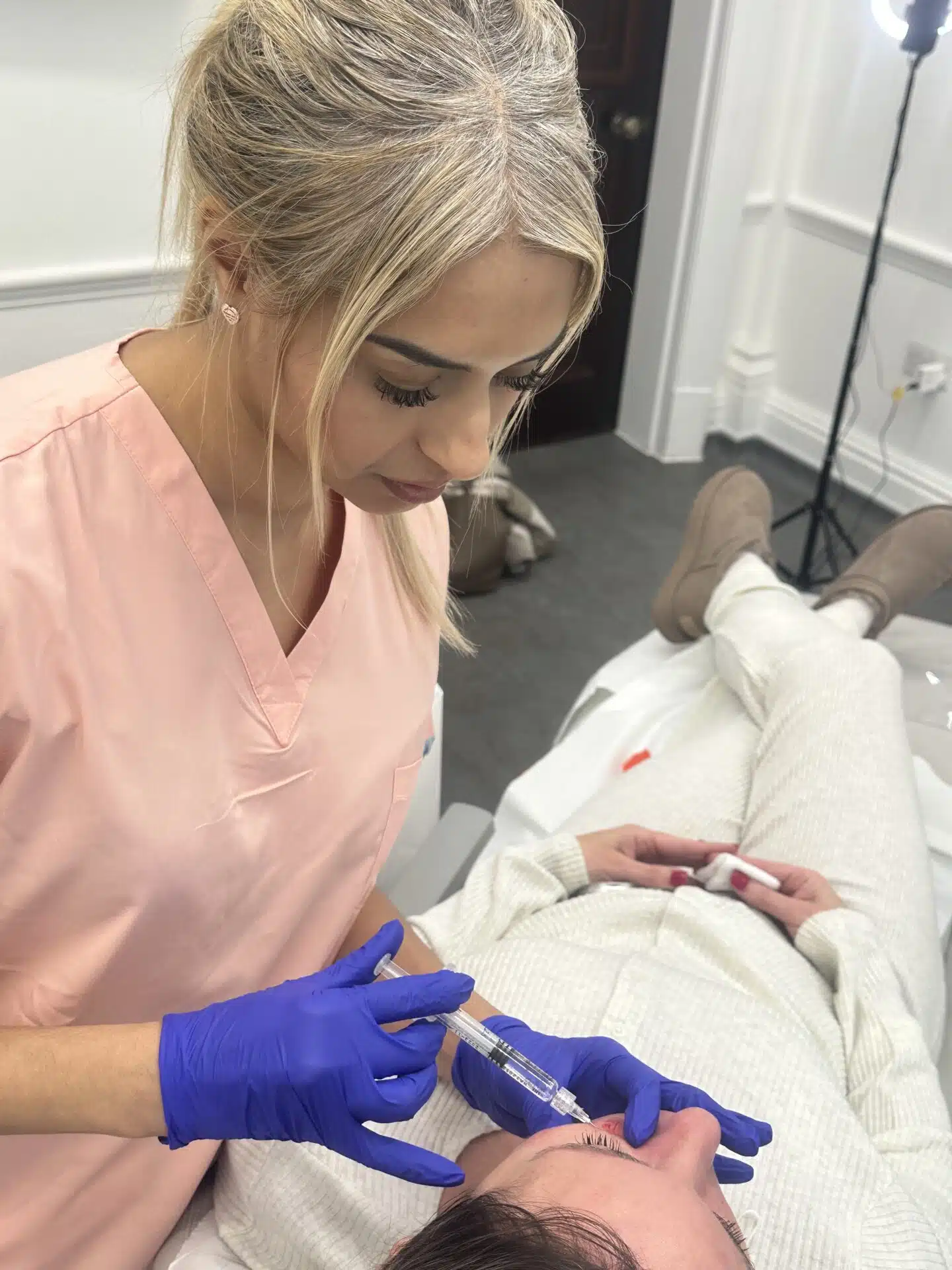
Clinically assessed treatment options to improve the appearance of acne scarring and uneven skin texture, planned around your individual skin and goals.
Acne scar treatment refers to a range of clinical approaches used to improve the appearance of scarring left by acne, including laser resurfacing, microneedling and chemical peels. The most suitable option depends on the type, depth and distribution of the scarring, and is determined following individual skin assessment at Orovenza, part of Contoura Medical.
Orovenza takes a consultation-led approach, assessing the skin before discussing which treatment pathway is most appropriate and what recovery to expect.
Treatment Information
Treatment Details
What It Treats
Selected types of acne scarring, including icepick, rolling and boxcar scars, and general uneven skin texture.
Treatment Options
Options may include CO2 laser resurfacing, microneedling or chemical peels, depending on scar type and skin assessment.
Downtime
Recovery varies according to the treatment selected and its intensity, and will be discussed during consultation.
Results Timeline
Improvement in scar appearance typically develops progressively over a course of treatment rather than after a single session.
The Process
How Acne Scar Treatment Works
Skin Assessment
The type and depth of your acne scarring are assessed alongside your general skin condition.
Treatment Planning
A treatment pathway is proposed based on your scarring and goals, with alternatives discussed where relevant.
Treatment
The selected treatment is carried out according to the agreed plan, often as a course of sessions.
Review
Your progress is assessed between sessions and the plan adjusted where appropriate.
By Dr Edwin Anthony, Lead Clinician, Contoura Medical · Treatments delivered by Nurse Rashmi Mehta · Last updated 4 October 2026
Acne scar treatment uses a planned combination of microneedling, radiofrequency microneedling, laser resurfacing and peels to soften rolling, boxcar and ice pick scars. At Orovenza in Marylebone, London, it is for adults whose acne is controlled and who want realistic, lasting improvement.
What it is and how it works
Acne scars form when deep inflammation damages collagen in the dermis. The skin heals unevenly, leaving depressions or, less often, raised scars. The first step is identifying which types you have.
Rolling scars: wide, soft undulations with sloping edges. They often flatten when you stretch the skin and respond well to collagen stimulation.
Boxcar scars: round or oval depressions with sharp, defined edges. Shallow ones improve with resurfacing; deeper ones need more targeted work.
Ice pick scars: narrow, deep, V-shaped pits. DermNet reports they make up 60% to 70% of atrophic acne scars, and they are the hardest to shift.
Marks versus true scars: red or brown flat marks left after spots are post-inflammatory erythema or pigmentation. They usually fade with time and the right care, whereas true scars change the skin's surface and are usually permanent.
Treatments work at different depths, so layering them over several months usually beats repeating one treatment.
Who it is best suited for
Adults with rolling, boxcar or ice pick scars on the face.
People whose acne has been settled for at least a few months.
Those with a mix of true scars and leftover red or brown marks.
People ready for a course over several months, with daily SPF.
Your treatment journey at Orovenza
Consultation and skin assessment. Nurse Rashmi Mehta maps your scars under angled light, takes photographs and reviews your acne history and medication.
Plan and skin preparation. You get a staged plan, for example microneedling or Morpheus8 Scale & Burst first, followed by CO2 laser resurfacing or peels. Most people prepare with SPF and a gentle routine for two to four weeks; darker skin may also need a pigment-calming cream.
Treatment day. Numbing cream is applied, then the planned treatment is carried out. Sessions usually take 30 to 60 minutes.
Aftercare. Written aftercare specific to that treatment, a recommended product routine and a number to call if anything worries you.
Review. We review you between stages, compare photographs and change the plan if some scars are responding better than others.
Combination plans we use
Microneedling: gentle collagen stimulation for rolling and shallow boxcar scars, and a good start for darker skin.
Morpheus8 Scale & Burst: radiofrequency microneedling with heat at several depths, for deeper rolling scars.
CO2 laser resurfacing: fractional laser to soften boxcar edges and overall texture.
Chemical peels: refine the surface and fade red and brown marks alongside scars.
Results and how long they last
Improvement is gradual and measured in months. The American Academy of Dermatology states that a course of 3 to 5 microneedling treatments, performed every 2 to 4 weeks, has been found in studies to fade acne scars by 50% to 70%. It also advises that if you still have breakouts, treatment usually begins with getting the acne under control.
For mild peels, the AAD notes 3 to 5 sessions spaced 2 to 4 weeks apart are typical. Improvement from new collagen tends to last, but new acne can cause new scars. The realistic aim is clear softening, not removal.
Recovery and aftercare
Microneedling: redness for 1 to 3 days, light flaking around day 3 to 5, back to normal within about a week.
Morpheus8 Scale & Burst: redness and swelling for 2 to 5 days, sometimes tiny grid marks that fade within a week.
CO2 laser resurfacing: redness, swelling and peeling for about a week, with pinkness that can last several weeks.
Chemical peels: anything from mild tightness for a day to peeling for up to a week, depending on depth.
After every treatment: no makeup for 24 hours, no picking, gentle cleansing, a bland moisturiser and SPF 50 every day.
Safety, side effects and who should avoid it
Temporary redness, swelling and tenderness are expected after any of these treatments.
Pigment change, particularly darkening in deeper skin tones, is the main risk to manage, which is why we prepare skin carefully.
Cold sores can flare; tell us if you get them so we can arrange antiviral cover.
Not suitable with active acne, recent isotretinoin, keloid scarring, skin infection or pregnancy.
Comparing acne scar treatments
Treatment
Best for
Typical downtime
Usual sessions
Darker skin suitability
Microneedling
Rolling and shallow boxcar scars
1 to 3 days
3 to 5
Generally well suited
Morpheus8 Scale & Burst
Deeper rolling scars, texture, laxity
2 to 5 days
2 to 3
Usually suitable with careful settings
CO2 laser resurfacing
Boxcar scars, overall texture
About a week, pinkness longer
1 to 3
Higher pigment risk, detailed assessment needed
Chemical peels
Red and brown marks, fine texture
0 to 7 days
3 to 6
Superficial peels often suitable
How Orovenza compares
A hospital setting at Langham Hospital, 77 Hallam Street, Marylebone.
Nurse-led treatment by Nurse Rashmi Mehta, with medical oversight from Dr Edwin Anthony (GMC 4776646), Lead Clinician at Contoura Medical.
A consultation before every treatment, so each stage is checked against how your skin is responding.
A fixed consultation fee that is not deducted from treatment prices, with no pressure to book on the day.
Review appointments with standardised photographs, so you can judge progress honestly.
Your plan starts with an in-person scar assessment at Langham Hospital. Consultation fees are fixed and are not deducted from treatment prices, and your practitioner confirms your personal treatment cost at consultation. Call 020 3890 1911 or Book a consultation
Frequently asked questions
How much does acne scar treatment cost?
Cost depends on your scar types, how many treatments are combined and how many sessions you need. Someone with mild rolling scars may need a short microneedling course, while deeper mixed scarring needs a staged plan. Your practitioner confirms your personal cost at consultation, and the fixed consultation fee is separate.
Can acne scars be removed completely?
No treatment can reliably erase acne scars, and anyone promising that should be treated with caution. What a good plan can do is make scars shallower and less noticeable, so skin looks smoother in normal light. The amount of improvement depends on scar type, depth and how your skin heals.
What is the best treatment for ice pick scars?
Ice pick scars are narrow and deep, so surface treatments alone rarely reach them. They usually need targeted treatment of each scar followed by resurfacing such as CO2 laser or radiofrequency microneedling. We may refer you to a doctor for methods we do not offer, and we will tell you plainly if so.
Can I treat acne scars while I still have active acne?
Not usually. Treating scars over active spots can worsen inflammation and risk new scarring. We first help you get breakouts controlled, sometimes alongside your GP or a dermatologist. Once the skin has been settled for a few months, and any isotretinoin course has finished long enough, we can start.
How many sessions does acne scar treatment take?
Most plans involve four to six sessions over six to twelve months, combining treatments in stages. Microneedling courses are often three to five sessions, while CO2 laser is usually one to three. We review you between stages so the plan reflects how your scars are actually responding.
Does acne scar treatment hurt?
We apply numbing cream beforehand, so most people feel heat, pressure or prickling rather than sharp pain. Radiofrequency microneedling and CO2 laser feel more intense than standard microneedling. Discomfort afterwards is usually like a sunburn and settles within a day or two with cool compresses.
Is acne scar treatment safe for darker skin?
Yes, with the right plan. Microneedling is generally safe for all skin tones, and radiofrequency microneedling is often preferred over aggressive lasers. The main risk is temporary darkening of the skin, so we prepare the skin in advance, choose conservative settings and ask for strict sun protection throughout.
Is Morpheus8 Scale & Burst or CO2 laser better for acne scars?
Both can help, and many plans use both. Morpheus8 Scale & Burst works deeper with heat and suits rolling scars and darker skin. CO2 laser resurfaces the surface and is strong for boxcar edges and texture, with more downtime. Your scar pattern and skin type decide which comes first.
When will I see results from acne scar treatment?
Some smoothing appears within weeks as swelling settles, but collagen remodelling takes three to six months after each stage. Most people judge the full effect around six months after the final session. Comparing photographs is more reliable than the mirror, as day-to-day changes are hard to see.
How long do acne scar results last?
Improvement from new collagen is generally long lasting. However, new breakouts can create new scars, and natural ageing slowly affects skin texture. Keeping acne controlled, wearing daily SPF and occasional maintenance treatments help you hold on to the result for years.
Pricing depends on the treatment plan and number of sessions required. Your practitioner will confirm the cost of your personal treatment plan at consultation. Consultation fees are fixed and are not deducted from treatment prices.
Nurse Rashmi Mehta is the Aesthetic Nurse for Orovenza non-surgical aesthetics service at Contoura Medical.
Orovenza provides a clinically led approach to non-surgical aesthetic treatments, with treatment planning centred on individual assessment, appropriate indications and natural-looking outcomes.
Patients are assessed before treatment so that the most appropriate option can be discussed based on their goals and clinical circumstances.
To provide the best experiences, we use technologies like cookies to store and/or access device information. Consenting to these technologies will allow us to process data such as browsing behaviour or unique IDs on this site. Not consenting or withdrawing consent, may adversely affect certain features and functions.
Functional
Always active
The technical storage or access is strictly necessary for the legitimate purpose of enabling the use of a specific service explicitly requested by the subscriber or user, or for the sole purpose of carrying out the transmission of a communication over an electronic communications network.
Preferences
The technical storage or access is necessary for the legitimate purpose of storing preferences that are not requested by the subscriber or user.
Statistics
The technical storage or access that is used exclusively for statistical purposes.The technical storage or access that is used exclusively for anonymous statistical purposes. Without a subpoena, voluntary compliance on the part of your Internet Service Provider, or additional records from a third party, information stored or retrieved for this purpose alone cannot usually be used to identify you.
Marketing
The technical storage or access is required to create user profiles to send advertising, or to track the user on a website or across several websites for similar marketing purposes.